
The Birth of Compak Sporting: Why the Sport Needed a Compact Format
Compak sporting stands today as one of the most dynamic and accessible disciplines within the world of clay shooting. Although closely connected to traditional sporting clays, compak sporting is not simply a simplified version of the sport. It emerged as a response to the logistical, spatial, and competitive challenges that clubs and shooters faced as clay sports expanded worldwide. In French-speaking regions, the discipline often appears under terms like “compak sportif”, “parcours compact”, or within FITASC documents as part of “tir aux plateaux”.
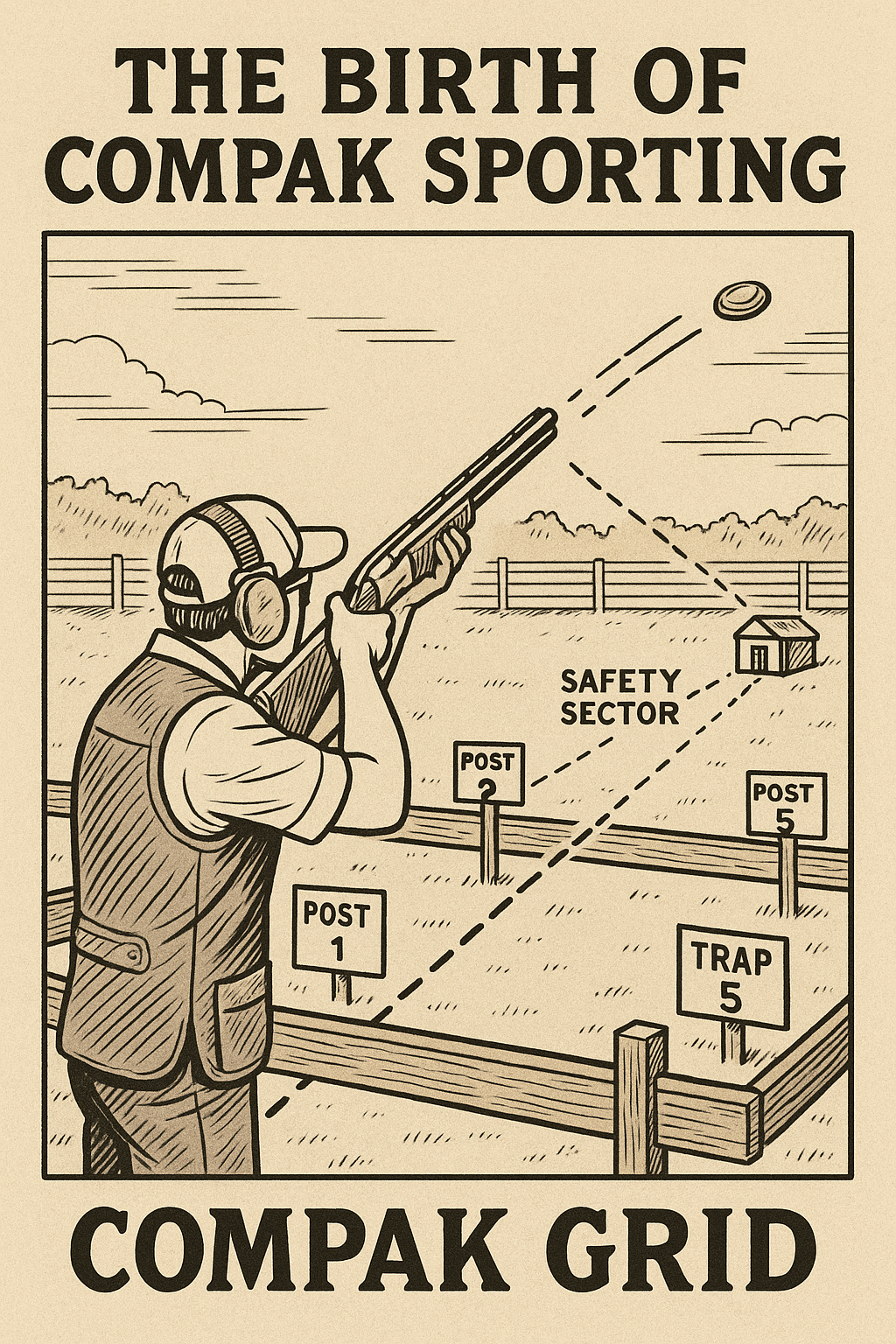
This article explores how compak sporting was born, why it became necessary, and how it transformed into a global discipline governed by strict standards and celebrated worldwide.
Early Context: The Limitations of Traditional Sporting
Large fields, large routes, large costs
Traditional sporting clays (or sporting parcours de chasse) grew rapidly throughout the 20th century. The discipline required:
- wide natural areas
- long walking routes
- multiple traps spread across terrain
- complex logistics
While this created variety and realism, it also introduced several difficulties for clubs and organizers.
Growing pains of an expanding sport
As the sport spread across Europe and later North America, new problems surfaced:
- many clubs lacked space
- urban and suburban shooting grounds struggled to host large parcours
- competitions were slow and difficult to standardize
- weather often interrupted long courses
- international rules varied dramatically
The sport needed a second format: faster, more compact, easier to build, and globally consistent.
The First Attempts to Miniaturize Sporting
Early experiments
Before compak sporting became an official discipline, several clubs in France, Italy, and the UK experimented with:
- short parcours
- minimalistic layouts
- single-zone shooting frames
- simplified trap arrangements
Shooters often referred to these as “mini sporting”, “parcours réduit”, or “five-position layouts”.
These prototypes served as the blueprint for what would later become compak sporting.
The Moment FITASC Stepped In
The true birth of compak sporting began when FITASC (Fédération Internationale de Tir aux Armes Sportives de Chasse) recognized the need for a compact, globally unified format.
FITASC’s vision
FITASC aimed to create a discipline with:
- fixed rules
- repeatable course design
- equal conditions worldwide
- high sporting quality
- limited spatial requirements
This led to the introduction of the compak grid — a set of geometric rules defining the exact shooting area, angles, safety limits, and placement of traps.
What Makes Compak Sporting a Unique Discipline
1. A Clearly Defined Shooting Grid
Compak sporting takes place inside a rectangular, fenced grid known in French as the “grille compak”.
Inside this grid are:
- five shooting posts (postes de tir 1–5)
- safety sector lines
- trap placement zones
This structure ensures universal safety and fairness.
2. Multi-trap diversity within a compact space
Although compact, each field features:
- 6 to 8 traps
- multiple angles (left, right, central)
- rabbits (lapins roulants)
- battues (plateaux battue)
- chandelle/vertical teal (plateau chandelle)
The variety mimics full sporting without requiring large land areas.
3. Faster and more dynamic competitions
Unlike traditional sporting:
- shooters remain in one zone
- transitions between posts are immediate
- pairs are thrown rapidly
- spectators can observe the entire layout
These qualities made compak ideal for intense, exciting competitions.
Why the Sport Needed a Compact Format
Space Efficiency
Compak fields can fit into:
- small rural clubs
- suburban environments
- multi-sport complexes
- temporary competition sites
Easier Organization
A full competition can run:
- with fewer volunteers
- in limited time
- under controlled safety conditions
Standardization
Compak sporting allowed FITASC to guarantee consistent rules globally, something traditional sporting struggled with due to its free-form nature.
Accessibility
The format opened the door for:
- beginners
- youth programs
- clubs with limited budgets
- urban shooting communities
Compak provided a new entry path into the world of clay shooting.
Key Terms That Define the Discipline
Posts / Postes — fixed shooting positions
Compak Grid / Grille Compak — defined shooting area
Pairs (On-Report / Simultaneous) — timing-based clay releases
Dead Zone / Zone Neutre — area where shooting is prohibited
Safety Sector / Secteur de sécurité — angles marked for safe shooting
These terms created a technical vocabulary that reshaped the discipline.
A Discipline Born From Necessity
“Compak sporting did not replace sporting. It completed it.” – FITASC Technical Committee
By solving practical limitations — space, logistics, standardization — compak sporting became a modern answer to the needs of a growing sport. Within a decade of its formalization, it earned its place as a full international discipline.
Global Expansion and Major Competitions
Compak sporting is now part of major competitions worldwide:
- FITASC Compak Sporting World Cup
- FITASC European Compak Championships
- National Compak Championships (various countries)
- Grand Prix FITASC Series
The sport has grown thanks to its accessibility, structure, and excitement.
Compak Sporting Today: A Perfect Balance
Modern compak sporting combines:
- the tactical depth of sporting
- the dynamics of fast-paced shooting
- the precision of standardized layouts
- the universal accessibility of compact ranges
It is now one of the fastest-growing clay sports disciplines in the world.

 ClayMaster Hub