
France’s Sporting Clay Culture Today: A Modern Look at Ball-Trap, Community, and Craft
In France, clay shooting has grown into something far beyond a recreational pastime. Known collectively as ball-trap, the sport occupies a unique space in French outdoor culture — part tradition, part technical discipline, part social ritual.
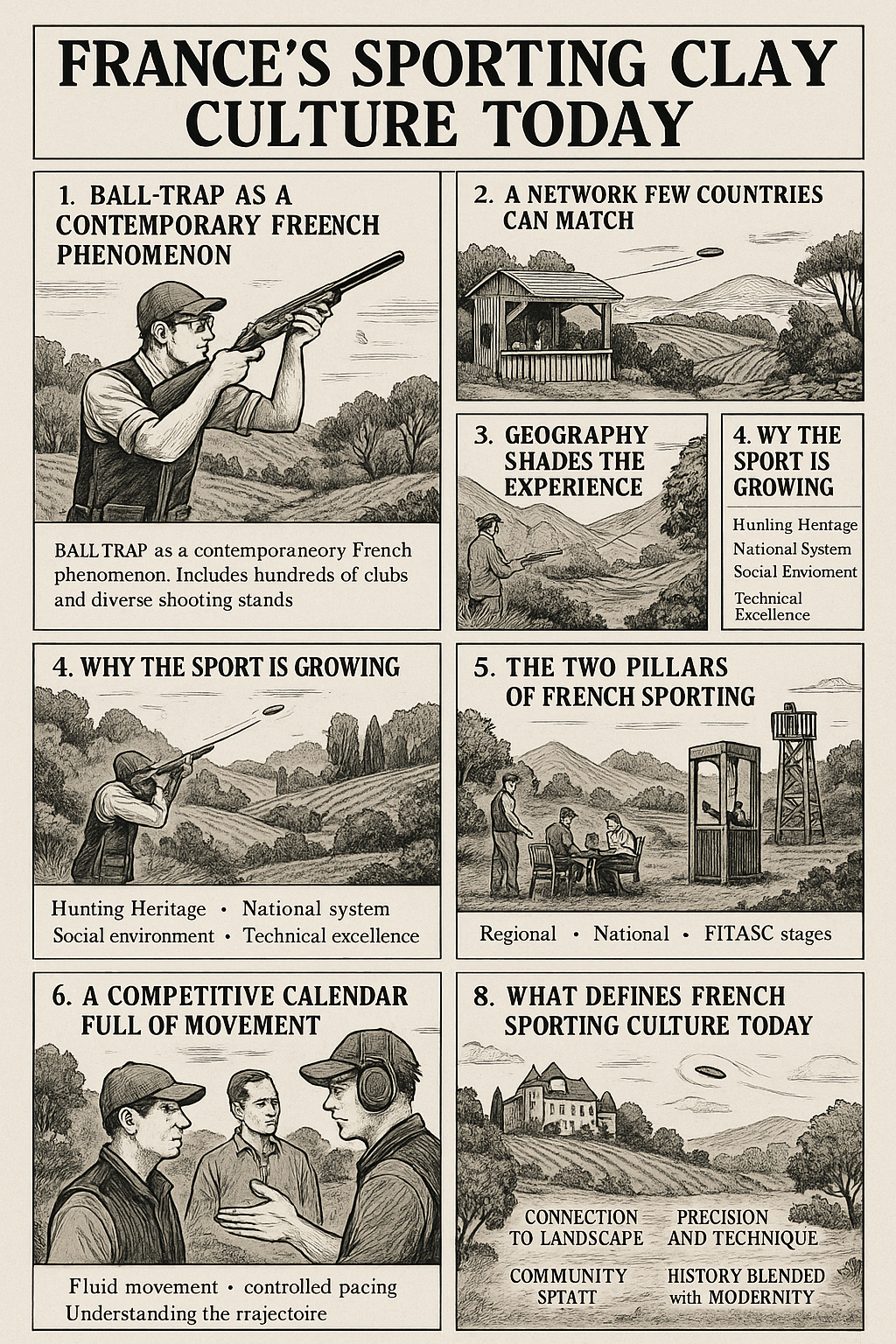
Rather than being confined to shooting ranges alone, sporting clays in France have expanded into an entire ecosystem of clubs, athletes, coaches, landscapes, and long-standing habits that define how the French approach precision sports.
1. Ball-Trap as a Contemporary French Phenomenon
The term ball-trap is broad and inclusive. It covers every clay-target discipline practiced across the country — from the Olympic fosses to skeet fields and hélices. But the strongest cultural presence today comes from two disciplines:
- Parcours de Chasse (PC) — natural, terrain-driven sporting
- Compak Sporting (CS) — structured, compact layouts with controlled shooting sectors
Together, they shape how modern France experiences clay shooting: outdoors, authentic, technical, and distinctly its own.
2. The Infrastructure: A Network Few Countries Can Match
France has quietly built one of Europe’s largest and most accessible clay-shooting networks.
With hundreds of active shooting clubs scattered across the map, the sport is easy to reach, even for beginners.
A typical French stand de ball-trap often blends multiple elements:
- Cages for Compak Sporting
- Hillsides or woodlands for Parcours de Chasse
- Launch towers, ravines, and forest corridors
- Diverse machines generating battue, chandelle, lapin roulant, and other French-style trajectories
- Terraces, small cafés, and social spaces where shooters gather between rounds
This combination of sport and social atmosphere is a defining feature of the French approach.
3. Geography Shapes the Experience
Unlike many countries where sporting layouts rely on artificial obstacles, French courses often use natural terrain as the primary design element.
This means shooters may encounter:
- targets rising along rocky slopes,
- crossers flying low between trees,
- battues streaking over open grassland,
- rabbits running along vineyard paths.
The result is a sporting culture intimately tied to the land.
4. Why the Sport Is Growing
Several factors contribute to the continuous rise of sporting clays in modern France:
A deep hunting heritage
Many participants come from the hunting community, using PC and CS as training tools during the off-season.
A structured national system
France’s federations and clubs maintain a strong calendar of regional and national events, encouraging constant participation.
A welcoming social environment
Shooters frequently stay long after their rounds are finished, discussing techniques, equipment, and memorable targets.
A focus on technical excellence
French shooters often prioritize fundamentals — smooth épaulement, clean ligne de mire, and thoughtful avance — creating a disciplined and methodical culture of practice.
FITASC’s influence
With FITASC headquartered in France, the country naturally maintains a leadership role in rules, standards, and international events.
5. The Two Pillars of French Sporting
Parcours de Chasse (Sporting)
PC in France reflects the philosophy of “nature as the course.” Instead of forcing the landscape to fit the discipline, the discipline adapts to the landscape.
This is where shooters encounter some of the most creative trajectories in Europe — battues that flip unpredictably, high tower birds that challenge timing, and long crossers shaped by wind.
Compak Sporting
Compak, by contrast, concentrates the sporting experience into a smaller area.
Five posts, clearly defined boundaries, and a constant flow of:
- simultaneous pairs,
- on-report pairs,
- rapid rabbits,
- low crossers,
- and vertical chandelles.
The format is dynamic, rhythmic, and popular among both novices and competitive shooters.
6. A Competitive Calendar Full of Movement
France’s tournament system is one of the most active on the continent.
Throughout the year, clubs host:
- regional competitions,
- club championships,
- national PC and CS events,
- FITASC stages and qualifiers.
The variety of terrains and course-setting styles ensures that no two events feel the same.
7. A Distinct Shooting Philosophy
The French shooting style emphasizes:
- fluid movement
- controlled pacing
- understanding the trajectory
- avoiding sudden or exaggerated motions
Coaches often stress reading the target rather than forcing the shot.
A commonly shared idea among French instructors is:
“The shot should follow the target’s logic, not your impatience.”
This mindset shapes how shooters train, compete, and discuss their sport.
8. What Defines French Sporting Culture Today
The essence of modern French sporting can be summarized through several pillars:
- Connection to landscape — courses that breathe with the terrain
- Community spirit — clubs as social centers
- Precision and technique — a methodical, thoughtful approach
- History blended with modernity — FITASC heritage meets contemporary practice
- Aesthetic appreciation — clay shooting seen as a craft, not just an activity
In France, sporting clays functions almost like a cultural language — something understood intuitively by communities across the country.
Conclusion
The modern culture of sporting clays in France stands at the intersection of tradition, terrain, and technique.
It is shaped by a widespread network of clubs de ball-trap, by shooters who value precision, and by a national character that treats clay shooting as a refined craft rather than a simple sport.
Whether through Parcours de Chasse or Compak Sporting, France continues to define a distinct, influential, and deeply rooted approach to clay shooting — one that blends authenticity with innovation and remains one of the strongest in Europe.

 ClayMaster Hub